


TALLHEDA 3rd Brainstorming Visit to the University of Novi Sad!

Updated: Feb 13
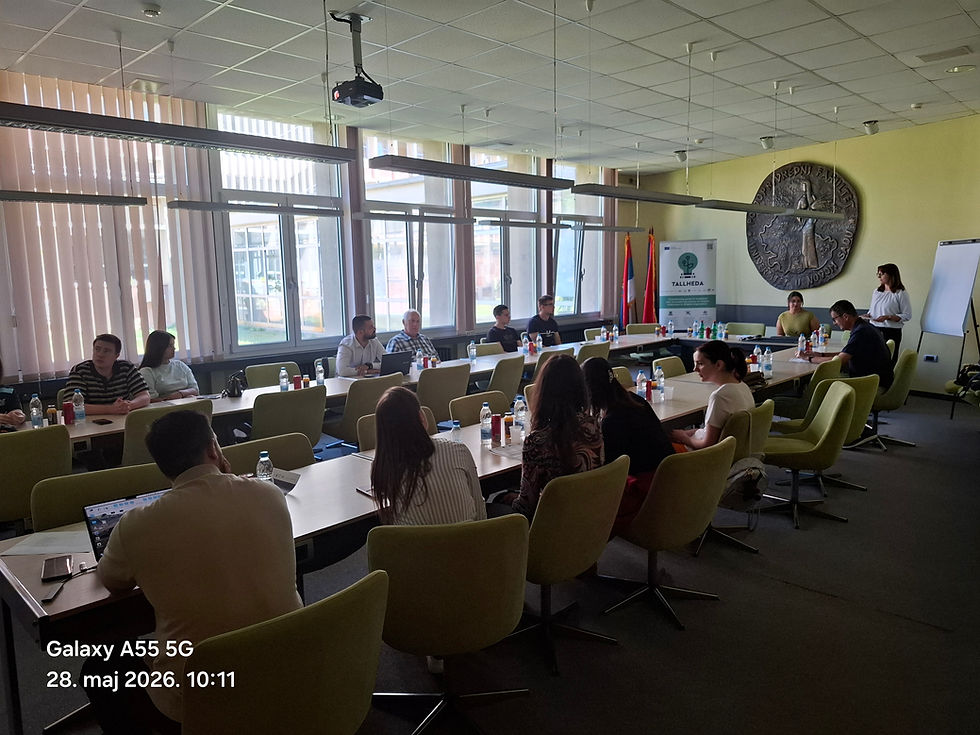
The 3rd round of TALLHEDA brainstorming visits was successfully held at the University of Novi Sad – Faculty of Agriculture (UNSFA) in December 2025, bringing together international experts, researchers, academic staff, and students to advance dialogue and collaboration in Digital Agriculture (DA).
Organised within the framework of the TALLHEDA Horizon Europe project, the visit took place on 15–16 December and 17 December 2025 and hosted partners from ILVO, Smart Agro Hub and TERRA, alongside representatives of UNSFA. The event reinforced TALLHEDA’s mission to strengthen scientific capacity, knowledge exchange, and innovation in digital agriculture among widening higher education institutions.
AI and Digital Twins in Livestock Farming
The first part of the visit, held on 16 December, focused on AI and Digital Twins in livestock farming. The session was opened by Prof. Dr. Mila Grahovac, Vice Dean for Science and International Cooperation at UNSFA, who welcomed participants and highlighted the importance of international cooperation for accelerating digital transformation in agriculture.

The main brainstorming lecture was delivered by Dr. Pieter-Jan De Temmerman (ILVO, Belgium), who presented current developments in sensor technologies, camera systems, and data-driven monitoring across the livestock production chain. The lecture introduced Digital Twins as a powerful framework that connects real-time sensor data with virtual representations of animals, housing systems, and slaughter processes. Such systems can support monitoring, prediction, and decision-making related to animal growth, welfare, environmental conditions, and production efficiency.
You can find the presentation here:
The subsequent discussion emphasized that, while digital technologies are increasingly available, their potential is still underutilized in everyday farm management. Participants highlighted challenges related to data quality, model reliability, interoperability, and the translation of complex data into farmer-oriented decisions. The importance of stakeholder involvement, trust-building, and targeted capacity building was repeatedly underlined as essential for successful implementation of AI and Digital Twin solutions in livestock farming.
The afternoon program showcased UNSFA research activities through presentations on remote monitoring and innovative pesticide application technologies and soil organic matter assessment using machine learning and satellite imagery. Participants also visited the Digital Agriculture laboratory, gaining insight into ongoing research and applied solutions developed at UNSFA. The day concluded with a networking dinner, fostering informal exchange and future collaboration opportunities.
Supporting Farmers on the Journey to Digital Farming
On 17 December 2025, the brainstorming visit continued with a strong focus on the human and organizational aspects of digitalization in agriculture. Mr. Nikola Kopilović (TERRA) delivered a lecture entitled “Journey to Digital Farming: How to Support Farmers in Adopting Technologies?”, addressing why the uptake of digital agricultural technologies remains limited despite their growing availability. Also, a lecture titled "Digital Twins in open field crops, the models in the AI era" was delivered by Fotis Chatzipapadopoulos (Smart Agro Hub).
You can find the presentations here:
The presentations explored key barriers to adoption, including uncertainty about costs and benefits, cultural and generational factors, limited advisory support, and broader structural challenges. Particular attention was given to the role of advisors as intermediaries between research, technology providers, and farmers. The session also introduced the QuantiFarm data platform, demonstrating how recommendation tools and cost–benefit calculators can support informed, transparent, and farmer-centered decision-making.
Discussions highlighted that successful digital transformation depends not only on technology, but also on trust, economic stability, policy support, and a deep understanding of farmers’ values and real-life constraints. Participants stressed that tailored solutions, strong advisory systems, and continuous institutional support are critical for accelerating adoption, especially in challenging production environments.
On December 17th, the introductory lecture, delivered by Mr. Fotis Chatzipapadopoulos (SAH), explored how Digital Twin technology is driving the transition from Precision Agriculture (Agriculture 4.0) to Cognitive Agriculture (Agriculture 5.0).
From Digital Models to Living Digital Twins
A key highlight of the lecture was the clear differentiation between:
Digital Models – static systems with manual data exchange
Digital Shadows – real-time monitoring systems with one-way data flow
True Digital Twins – bi-directional, automated systems capable of predictive and prescriptive decision-making
Unlike industrial digital twins, agricultural systems must simulate irreversible biological growth processes under highly variable environmental conditions. This introduces the concept of the “Living Digital Twin”, capable of continuously synchronizing real-time data with mechanistic crop simulations.
The Cognitive Core: Mechanistic Crop Models
Participants explored the foundational role of well-established crop simulation platforms such as:
DSSAT
APSIM
STICS
AquaCrop

These models simulate processes such as photosynthesis, nutrient uptake, transpiration, and phenological development. The discussion emphasized that, while pure machine learning models often struggle under novel climate conditions, process-based models provide the mechanistic understanding necessary for extrapolation and long-term resilience.
The future lies in hybrid physics-AI architectures, where:
Machine Learning supports calibration and bias correction
AI surrogates accelerate simulation
Satellite imagery feeds crop parameters
Physics-informed neural networks embed agronomic constraints
AI Capabilities and Maturity Progression
The lecture presented four AI pillars enhancing Digital Twins:
Computer Vision – crop stress and pest detection
Predictive Analytics – improved yield forecasting
Optimization Algorithms – multi-objective decision-making
Natural Language Interfaces – reducing cognitive load for farmers
A five-level maturity model was outlined, progressing from static digital models to fully autonomous agricultural systems. Importantly, participants acknowledged that most commercial agriculture currently operates at intermediate levels of digital maturity.
You can find the presentation here:
You can find the take home messages here:


Comments